Cheetah are famous for one thing: their speed. But there is so much more to these spotted cats than their ability to accelerate across open plains.
From built-in “sunglasses” to surprisingly unusual feet, cheetahs have evolved a fascinating set of adaptations that make them one of Africa’s most distinctive predators. At Inverdoorn Private Game Reserve, cheetahs are part of the conservation story, giving guests the opportunity to see these remarkable animals during a cheetah educational and learn more about them.
15 cheetah facts that might surprise you:
1. Their claws don’t fully retract
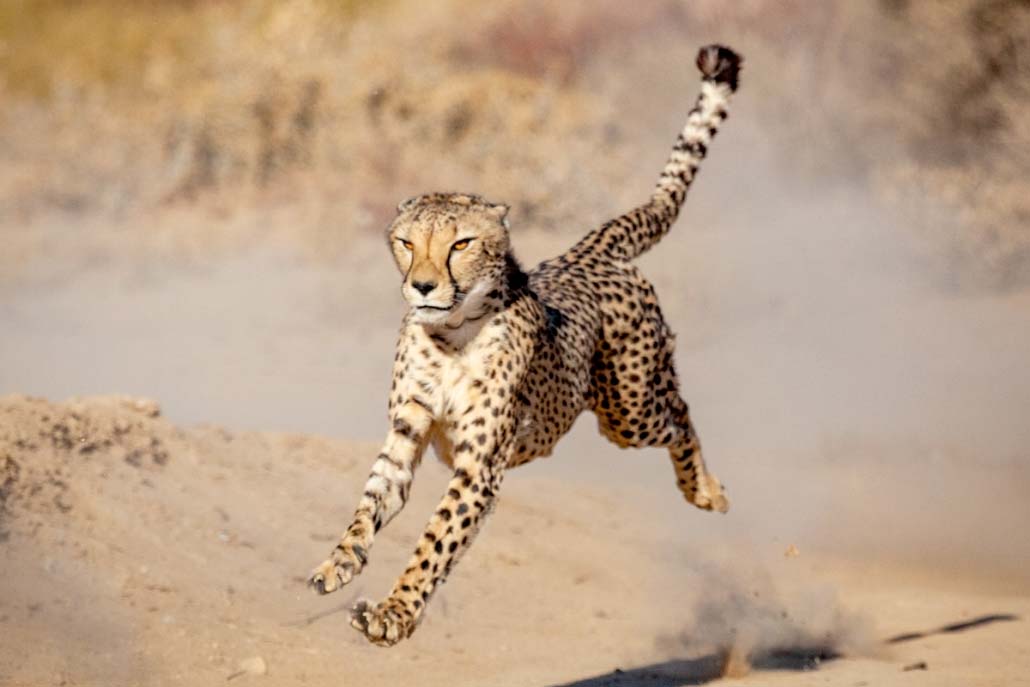
Unlike lions and leopards, cheetahs cannot fully retract their claws. Their claws remain partially exposed, providing additional traction when accelerating and changing direction. Their foot structure is also distinctive, with firm pads that help provide grip on the ground. Together, these adaptations are particularly useful during the short, high-speed pursuits for which cheetahs are known.
2. Their facial markings act as sunglasses
The dark lines running from a cheetah’s eyes towards the corners of its mouth are known as tear marks. Their exact function is not confirmed, but they are widely thought to help reduce glare from the sun, allowing the cheetah to maintain visual focus on prey. This is particularly relevant to a predator that relies heavily on sight and is often active during daylight hours.

3. A cheetah’s tail is essential for high-speed movement
The cheetah’s long tail (65-80cm long) is more than a striking feature. It plays an important role in balance and directional control while running. During a chase, a cheetah may need to make sudden changes in direction as its prey attempts to escape. The tail helps stabilise the animal and allows it to make these rapid adjustments without losing control.
4. Cheetahs are built for acceleration rather than endurance
The cheetah’s anatomy is highly specialised for short bursts of speed. Its lightweight body, long legs, flexible spine and large respiratory system allow it to accelerate rapidly (from 0 to 100km/h in 3 seconds).
However, this speed is sustainable only for a short period (20-30 seconds). A high-speed pursuit places considerable demands on the cheetah’s muscles and cardiovascular system, which is why hunts generally involve brief chases rather than prolonged pursuits. They take up to 30 minutes to recover from a high-speed chase.
5. Cheetahs have unusually large nasal passages
A cheetah’s large nasal passages allow increased airflow during intense physical exertion. This is one part of a respiratory system adapted to support rapid acceleration and sprinting. During a chase, the cheetah needs to deliver oxygen to its muscles quickly, making efficient respiration essential.

6. Cheetahs rely heavily on sight when hunting
Cheetahs are primarily visual hunters. Rather than relying on scent to locate prey, they use their excellent eyesight to identify and assess potential targets. They will often observe their surroundings before beginning a hunt, selecting an individual that can be approached within striking distance before the chase begins. This combination of patience and explosive acceleration is an important part of the cheetah’s hunting strategy.
7. Cheetahs are predominantly active during the day
Unlike many of Africa’s predators, cheetahs are predominantly diurnal. Being active during daylight hours allows them to use their excellent eyesight to hunt and can reduce direct competition with some predators that are more active at night. However, cheetahs still face competition from larger predators and may lose kills to lions, leopards and hyenas.
8. Male cheetahs can form lifelong partnerships
Female cheetahs are generally solitary outside of the period when they are raising cubs. Male cheetahs, however, may form coalitions, often with brothers from the same litter. These coalitions can remain together for many years and may cooperate in defending territories and competing with other males. It is one of the more unusual social structures among Africa’s big cats.
9. Cheetah cubs have a distinctive mantle
Young cheetahs have a long, greyish mantle of hair extending from the back of the head down the spine. The colouring provides camouflage and is thought to resemble the appearance of the honey badger, an animal that is generally avoided by many predators. As the cub matures, this distinctive mantle gradually disappears.
10. Their spots are unique to each individual
Every cheetah has its own arrangement of spots. This makes the markings useful for identifying individual animals during conservation and research. Photographs can be compared over time to monitor known individuals, their movements and changes within a population.
11. Cheetahs cannot roar
Cheetahs cannot roar like lions, but they are far from silent. They communicate through a range of vocalisations including purrs, growls, hisses and distinctive chirping or bird-like calls. Mothers and cubs, in particular, use vocal communication to locate and interact with one another.
12. Cheetahs can purr both when breathing in and out
Cheetahs belong to the group of cats known as purring cats. Their purr can be produced during both inhalation and exhalation. This differs from the roar-producing big cats, such as lions, which have a different structure in the throat that allows them to produce their characteristic roar.
13. Cheetahs are relatively small compared with other African big cats
An adult cheetah generally weighs considerably less than a lion or leopard. This lighter build is part of the species’ specialisation for speed. Cheetahs have sacrificed some of the physical strength associated with larger predators in favour of a streamlined body capable of rapid acceleration and agile movement.
14. Speed does not make the cheetah the dominant predator
Being the fastest land animal does not mean the cheetah sits at the top of the African predator hierarchy. Cheetahs are relatively lightly built and can lose kills to larger predators. For cheetahs, finding and securing a meal is therefore about much more than simply being able to outrun their prey.
15. There are less than 7500 cheetahs left in the wild
An estimated 6,500–7,100 cheetahs remain in the wild, with most found in southern and eastern Africa. Cheetahs are classified as Vulnerable, with habitat loss, human-wildlife conflict and declining prey among their key threats.
Cheetahs at Inverdoorn Private Game Reserve
Conservation
The Ceres Karoo provides an important setting for Inverdoorn’s cheetah conservation work. The reserve’s cheetah programme forms part of efforts to rehabilitate and reintroduce cheetahs into suitable natural environments, contributing to the restoration of the species in the Western Cape.
The Cape Cheetah Conservation Project focuses on rehabilitation, education and responsible wildlife management. Some cheetahs arrive at Inverdoorn from compromised backgrounds, requiring care and rehabilitation before they can be considered for release. For Inverdoorn, conservation is not separate from the safari experience. It is part of understanding the wildlife and landscape of the Karoo, and the work required to protect species that have become increasingly restricted in the wild.
Cheetah Educational Experience
The Cheetah Educational Experience gives you the opportunity to learn more cheetah facts with an experienced guide. The experience looks at cheetah biology, behaviour, hunting adaptations and conservation.
One of the highlights is observing the Cheetah Run. As part of the rehabilitation programme, cheetahs chase a mechanical lure along a runway, encouraging natural pursuit behaviour while providing exercise and enrichment. Guests watch from an elevated, zero-impact viewing position, rather than interacting with the animals.
It is an opportunity to see the cheetah doing what it is uniquely adapted to do: accelerate, manoeuvre and pursue at remarkable speed. At the same time, the experience offers a closer understanding of the conservation work behind the animals you are seeing.
The Cheetah Educational Experience, including the Cheetah Run, is an optional safari activity and is subject to availability.
Also see: Incredible Footage of Inverdoorn’s Cheetah Run

FAQ: Frequently asked questions about cheetahs
Can cheetahs roar?
No, cheetahs cannot roar. They make a range of noises including purrs, growls, hisses and bird-like chirping noises. They can also purr while breathing in and out.
How big are cheetahs?
Cheetahs are the smallest of the “big” African cats, with males typically weighing 50-72kg and females 40-60kg.
Are cheetahs good hunters?
Cheetahs have a hunting success rate of 50% for hunts under 60 seconds. Their high-speed sprints exhaust their bodies limiting them to short bursts.
Can cheetahs climb trees?
Yes, but they are not strong climbers. Cheetah cubs often climb trees while developing balance and coordination, but their semi-retractable claws are primarily adapted for traction when running rather than climbing.
Why can’t cheetahs retract their claws completely?
Their semi-retractable claws provide extra traction, helping them accelerate and make sharp turns during a chase.
What is the Cheetah Run at Inverdoorn?
The Cheetah Run is a conservation-focused experience where cheetahs pursue a mechanical lure along a designated runway. It provides exercise and enrichment while allowing visitors to observe their natural speed and pursuit behaviour from a safe viewing area.
Are cheetahs social animals?
Females are generally solitary, while males may form coalitions, often with brothers from the same litter.
What do cheetahs eat?
Cheetahs mainly prey on smaller to medium-sized animals such as antelope, including springbok and steenbok, as well as hares and other small mammals.